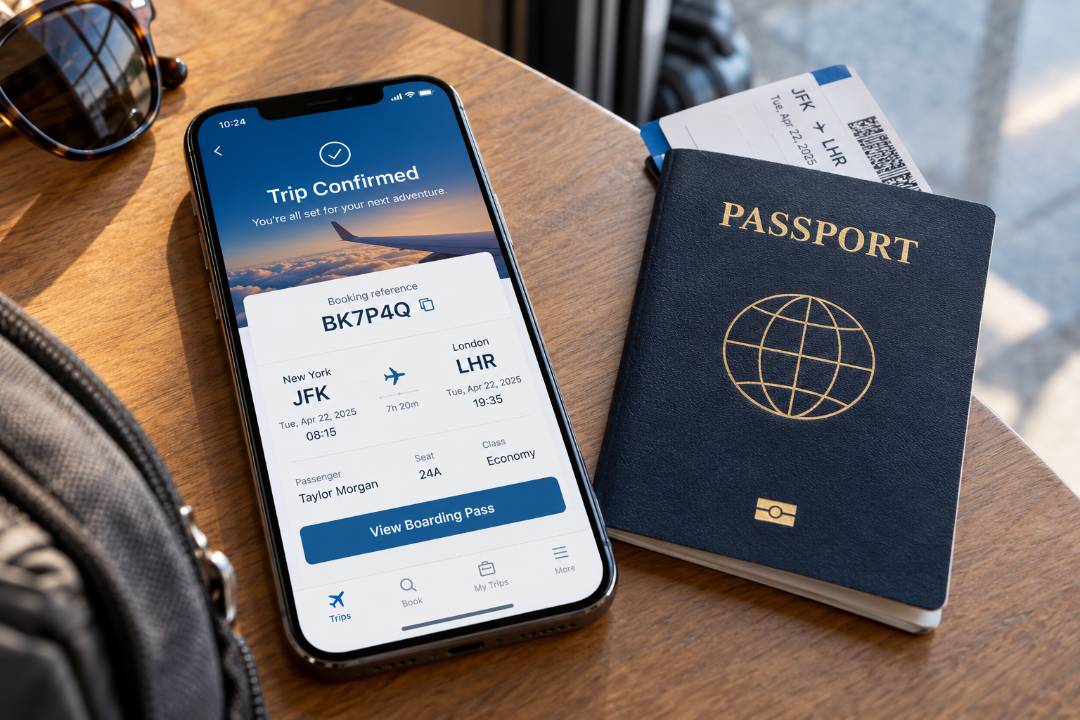

Every airline booking gets a short code within seconds of payment: six letters and numbers that look random but open the entire trip. This code points to the Passenger Name Record, or PNR, the file where an airline or travel agency stores everything about a reservation. The same code is needed at online check-in, at the airport desk at Heathrow or JFK, and whenever a seat, a bag or a date needs to change.
Airlines call the code by different names, which is one reason travelers get confused. This guide explains what a PNR is and what it contains, where to find it, what it unlocks, why one trip can have several of them, how it differs from a ticket number, how governments use PNR data, and why a boarding pass should never be posted online.
What a Passenger Name Record Is
A PNR is the reservation record for a journey booked by a passenger or on their behalf. It is created by an airline or its authorized agent, and when a trip is booked through a travel agency, the agency’s global distribution system (GDS) can create it as part of the booking workflow. The record exists in the reservation system, and the short code travelers see is its record locator, usually a six-character mix of letters and numbers.
A PNR is more than a name and a flight. At a minimum, it contains the passenger name, the itinerary, contact details, ticketing information and a received-from element that shows who made the booking or the last change. Over time it can also store seat assignments, special meal requests, frequent flyer numbers, extra baggage and requests for assistance at the airport.
The Amadeus travel glossary describes the PNR as the unique identifier travel providers and agents use to manage personal and booking information for a single trip. Besides flights, a PNR can hold hotel reservations, car rentals and special requests, which is why almost every service request, from a seat change to a refund, starts with this code.
Where to Find a PNR
The booking reference appears in several places, and airlines give it different names: confirmation code, booking reference, record locator, confirmation number or reservation code. All of these usually mean the same six-character PNR. Here is where to look:
- the booking confirmation email from the airline or travel agency, usually near the top;
- the e-ticket receipt or itinerary attached to the confirmation;
- the boarding pass, where it often appears as the confirmation code or booking reference;
- the airline app, in the trips or bookings section;
- the Manage Booking area of the airline’s website;
- the travel agency itinerary when the trip was bought through an agent or a booking site.
When a trip was booked through an agency, its confirmation may show the agency’s own locator rather than the airline’s. If the airline website does not recognize the code, the agency or the airline can provide the airline locator for the same booking. It also helps to save the code offline, as a screenshot or a note on the phone, because airport Wi-Fi and mobile data are not always available at the moment it is needed.
What a PNR Lets a Traveler Do
With a PNR and a last name, a traveler can open the booking on the airline’s website or app. That is the gateway to online check-in, issuing or reprinting a boarding pass, checking the itinerary and flight status, and updating contact details so the airline can send alerts about delays or gate changes.
The same code opens Manage Booking, where travelers can select or change seats, add checked bags or other services, request special assistance and, depending on the airline and fare rules, correct a name or change travel dates. Each airline sets its own fees and limits for these changes, so the fare conditions matter as much as the code.
Airlines ask for the PNR together with the last name for a reason. The PNR identifies the booking, while the surname adds a second check that matches the right passenger to the right record and reduces mix-ups. Without both pieces of information, the system will not open the reservation.
Why One Trip Can Have Several PNRs
A single journey is not always stored as one record. Amadeus notes that the link between a PNR and an itinerary depends on how many airlines are involved, on interline or codeshare agreements and on the booking system: a round trip or a connection booked with the same airline may share one PNR, while a mixed itinerary often does not. A travel agency or GDS can hold one booking file for the whole itinerary, while each airline keeps its own PNR for the flights it operates. That is why a traveler may see one code from the agency and another one on the airline’s website.
Codeshare and interline bookings work the same way: when one airline sells a flight that another airline operates, or when several carriers share an itinerary, each of them may create its own record for its part of the trip. Separate tickets naturally produce separate PNRs, large groups can be split into several records for operational reasons, and a split PNR can also appear after a schedule change or rebooking divides one original reservation. Online check-in for a flight operated by a partner airline usually needs that partner’s locator.
PNR vs E-Ticket Number
The PNR and the e-ticket number are often printed side by side, but they identify different things. The table below shows how the two codes compare.
| PNR (booking reference) | E-ticket number | |
|---|---|---|
| Format | Usually 6 letters and numbers | 13 digits, the first three identify the issuing airline |
| What it identifies | The reservation record with passengers, flights and services | The ticket document that was issued and paid for |
| When it appears | As soon as the reservation is created, even before ticketing | Only after the ticket is issued and linked to the PNR |
| After a schedule change | Usually stays the same and is updated with the new flights | Can change if the ticket is reissued |
| Main use | Online check-in, Manage Booking, flight status | Refunds, compensation claims and disputes |
| Where to find it | Confirmation email, boarding pass, airline app | E-ticket receipt, sometimes the boarding pass |
After a cancellation, the reservation is no longer active, but airlines keep the record history for servicing, refunds and rebooking. In practice, the PNR is the code for check-in and changes, while the ticket number proves that a ticket was issued and paid for. Keeping both in the same note on a phone saves time if something goes wrong.
How Governments Use PNR Data
Airlines do not keep PNR data only for themselves. In the European Union, the PNR Directive (EU) 2016/681 allows member states to process passenger data from flights to prevent, detect, investigate and prosecute terrorist offences and serious crime. The data can be kept for 5 years, but after 6 months it must be depersonalized by masking direct identifiers such as names, and full access after that point is allowed only under strict conditions. Processing of sensitive data is prohibited.
In the United States, Customs and Border Protection uses PNR data for the same broad purposes, including deciding which passengers need additional inspection. CBP keeps PNR data for 5 years in an active file and up to 10 more years in a dormant database, and depersonalizes it after 6 months by masking names, contact details and other personal information. The EU has found that US laws and CBP policies provide an adequate basis for transferring PNR data to the United States.
At the global level, ICAO recommends that states keep PNR data no longer than necessary, with a recommended maximum of 5 years after transfer, depersonalize it within 6 months and no later than 2 years after transfer, and be transparent with travelers about how the data is collected, used and protected. The European Commission explains the EU rules on its travel information page.
Other Meanings of PNR and How to Keep It Safe
The term also has another life outside aviation. Indian Railways uses PNR for its train bookings, but there it is a 10-digit number tied to a ticket that can cover one passenger or a group traveling together. Travelers enter this number in the railway’s enquiry system to check whether a booking is confirmed or waitlisted, and the number is printed at the top left of the ticket. IRCTC, the railway’s booking platform, describes it as a code generated by the passenger reservation system that holds the journey details.
Because a PNR and a last name are enough to open a booking, the code deserves the same care as a password. Boarding passes and confirmations also carry a barcode or QR code that links to reservation details, so photos of them posted on social media can give strangers access to seat selection, contact details or even changes to the trip. The barcode follows IATA’s Bar Coded Boarding Pass standard and stores, among other things, the passenger name, the booking reference and the flight. A screenshot of the flight on a phone is safer to share than a photo of the boarding pass.
The PNR also helps on travel day itself. After checking out of a hotel before a late flight, or during a long layover at airports like Los Angeles International Airport or Paris Charles de Gaulle, the booking code is all that is needed to check in later from a phone. A luggage storage service like Qeepl helps find a verified storage spot near airports, stations and city centers from US$3.50 per bag per day, so the free hours can go to the city instead of guarding a suitcase.