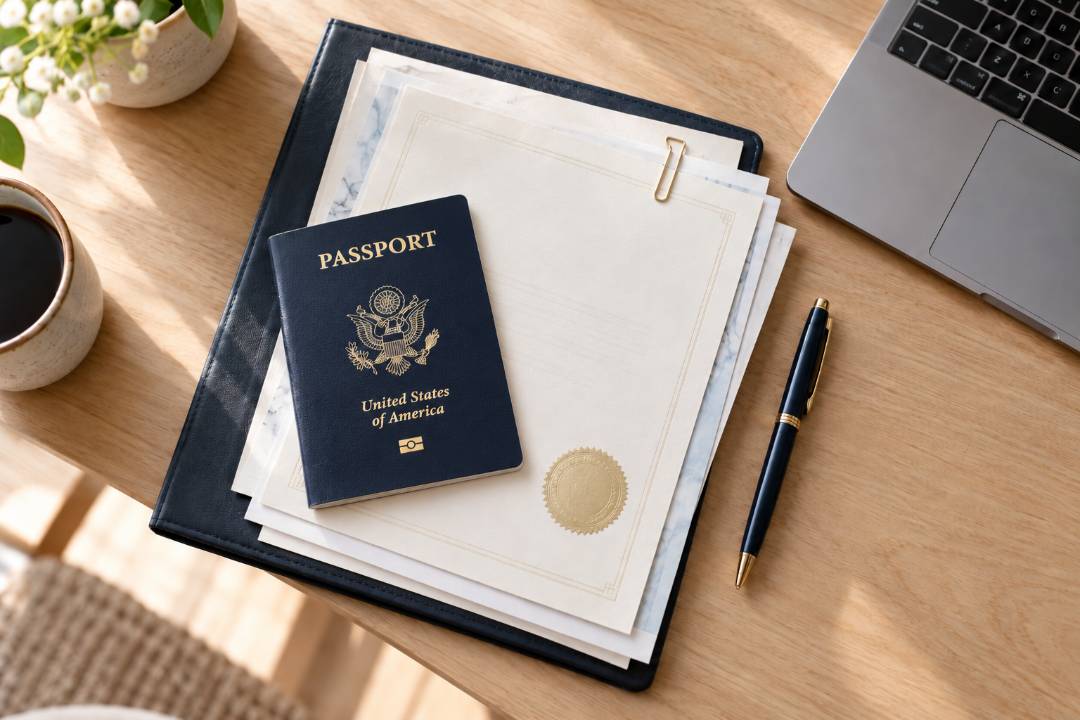

A long stay abroad starts months before the flight, because the slowest items on the list belong to government offices rather than to the traveler. Visa decisions, document certifications, and passport renewals each run on a separate calendar, and a delay in one pushes back the others. This guide sorts the preparation for living abroad by lead time, so the items with the longest waits get attention first.
Confirm Your Legal Route for a Long-Term Stay
A stay beyond a few months needs permission matched to its purpose, and that match decides which documents, appointments, and deadlines follow. The following checks come first.
Visa or Residence Requirements for Your Purpose of Stay
The purpose of a stay decides the permit category: employment, study, remote work, retirement, or family reunification. A long-stay visa usually enters the picture once the visit outgrows the visa-free period, which for Americans in the Schengen Area is 90 days within any 180-day window. Each category asks for its own evidence, such as a job offer, an enrollment letter, or proof of steady income.
Passport Validity and Application Appointments
Passport validity rules often require at least six months remaining beyond the planned stay, sometimes with blank pages as well. The U.S. Department of State publishes current renewal timelines:
- Routine service: four to six weeks.
- Expedited service: two to three weeks, for an extra $60.
- Mailing: up to two weeks in each direction.
Consular appointments for biometrics or interviews can book out for weeks, so the passport and the appointment belong on the same calendar.
Prepare Your Documents for Use Abroad
Foreign authorities want proof of identity, family status, education, and a clean record, all in a form they can verify. A typical set for a long stay includes:
- Certified birth and marriage certificates.
- Diplomas and transcripts, where study or professional licensing is involved.
- An FBI Identity History Summary, where the destination requests a criminal record check.
- Certified translations of each document, where the destination language differs.
Under the 1961 Hague Convention, a participating country accepts an apostille in place of embassy legalization. State-issued records receive it from the Secretary of State in the issuing state, while an FBI background check apostille comes from the U.S. Department of State in Washington, D.C. Federal processing by mail typically takes two to four weeks, which makes that leg the one to start first.
When the visa appointment date is close, an expedited FBI background check apostille compresses the federal step, and the state-level apostilles can proceed alongside it.
Arrange Healthcare and Prescription Access
Healthcare abroad rests on two pieces: coverage that works in the destination, and a medication plan that clears customs. Most U.S. plans offer limited coverage once the policyholder lives overseas, which makes health insurance for living abroad a separate purchase, and many long-stay visas ask for proof of it. Private international plans, local public enrollment after residency begins, or a combination of the two cover the main options.
For prescriptions, a supply covering the first months, the generic drug names, and a doctor’s letter ease customs and the first pharmacy visit. Some medications that are routine in the U.S. face restrictions abroad, so checking the destination’s rules before packing avoids surprises.
Plan Your Finances for Living Abroad
Researching the cost of living abroad through local rent listings, utility rates, and grocery prices grounds a budget in real numbers rather than U.S. habits. The areas below deserve early attention beyond that.
Moving Costs, Housing Deposits, and an Emergency Fund
Front-loaded expenses arrive in a cluster: airfare, shipping or storage, a housing deposit that often equals one to three months of rent, and fees for visas and document certifications. A reserve covering three to six months of living costs absorbs a delayed first paycheck, a late-starting lease, or an unexpected flight home.
Bank Account Access and International Payments
Expat banking usually combines three layers: the existing U.S. accounts, a local account for rent and daily spending, and a low-fee channel for transfers between them. Local banks often ask for a residence permit and proof of address before opening an account, and some are cautious about U.S. citizens because of American reporting rules.
Foreign accounts also carry U.S. reporting. The Report of Foreign Bank and Financial Accounts, known as the FBAR, is due when combined foreign balances exceed $10,000 at any point during the year.
Arrange Housing Before You Commit to a Lease

A short-term rental for the first few weeks leaves time to inspect neighborhoods, commute routes, and building conditions before signing a long contract. Viewing a property in person, or through a trusted local contact, protects against listings that exist on paper alone.
Before signing, a lease deserves a careful read for three points:
- The deposit amount and the conditions for its return.
- The notice period for ending the contract.
- The rules on early termination.
Landlords may also ask for proof of income or a guarantor, so recent pay records and a bank reference belong in the document folder.
Organize the U.S. Responsibilities You Leave Behind
American obligations continue after the move, and taxation comes first. Taxes for a US citizen living abroad still begin with Form 1040 on worldwide income, and filers residing overseas receive an automatic extension to June 15.
Two practical arrangements keep the household connected to home. A forwarding service or virtual mailbox keeps tax notices within reach, while absentee ballots are requested through the Federal Voting Assistance Program, with some states requiring a fresh request each year.
Enrollment in the Smart Traveler Enrollment Program adds a safety layer, since it gives the nearest embassy a way to reach a citizen during an emergency.
Final Thoughts
A long stay abroad comes together through sequencing. The legal route and the documents carry the longest waits; healthcare and finances follow, and housing and U.S. loose ends fill the remaining time. Starting with the slowest items turns the departure date into a plan instead of a deadline.