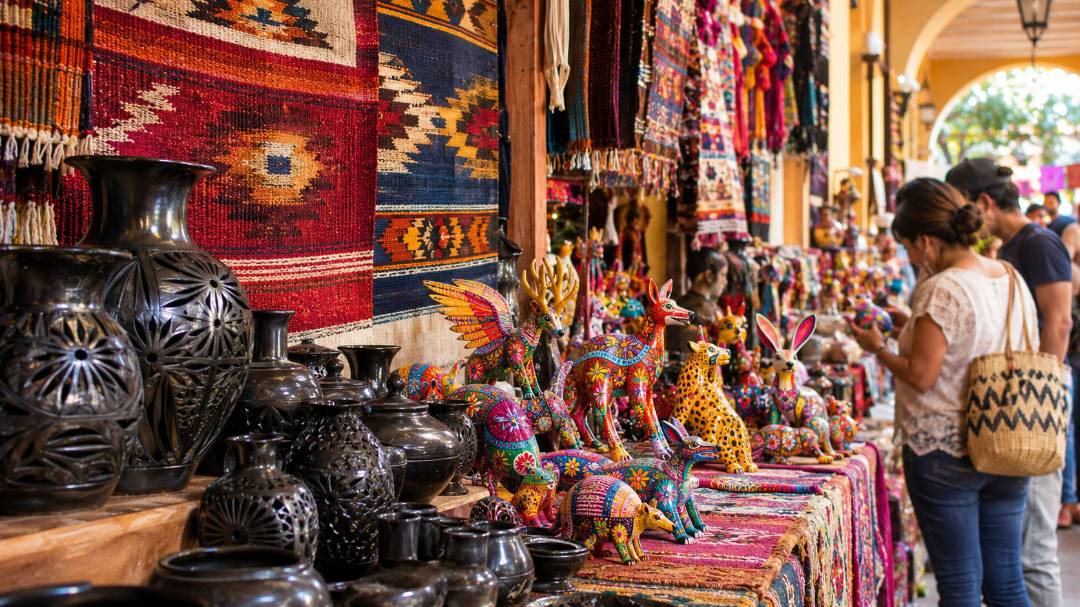

Oaxaca is one of the Mexican states with the richest craft traditions, and much of that wealth is less than an hour from the capital. In the Central Valleys there are entire villages devoted to a single craft: alebrijes carved from copal wood, burnished black clay, green glazed pottery and wool rugs dyed with cochineal.
This guide covers where to buy crafts in Oaxaca, which village to visit for each craft, how to recognize an authentic piece, which markets to visit depending on the day of the week and how to plan a day trip from the city.
Why Buy Directly in the Craft Villages
Buying at the workshop has clear advantages. You meet the person who made the piece, you see the process and all the money goes to the artisan family, with no middlemen.
In many villages in the Central Valleys, crafts are the backbone of the local economy. In San Antonio Arrazola, according to Visit México, about 80% of families make alebrijes, and in San Martín Tilcajete woodcarving supports most households.
Workshops are usually in the artisans’ own homes, with pieces displayed in courtyards and living rooms. Just walk the streets and step in wherever you see a sign for an open workshop.
Alebrijes From San Antonio Arrazola and San Martín Tilcajete
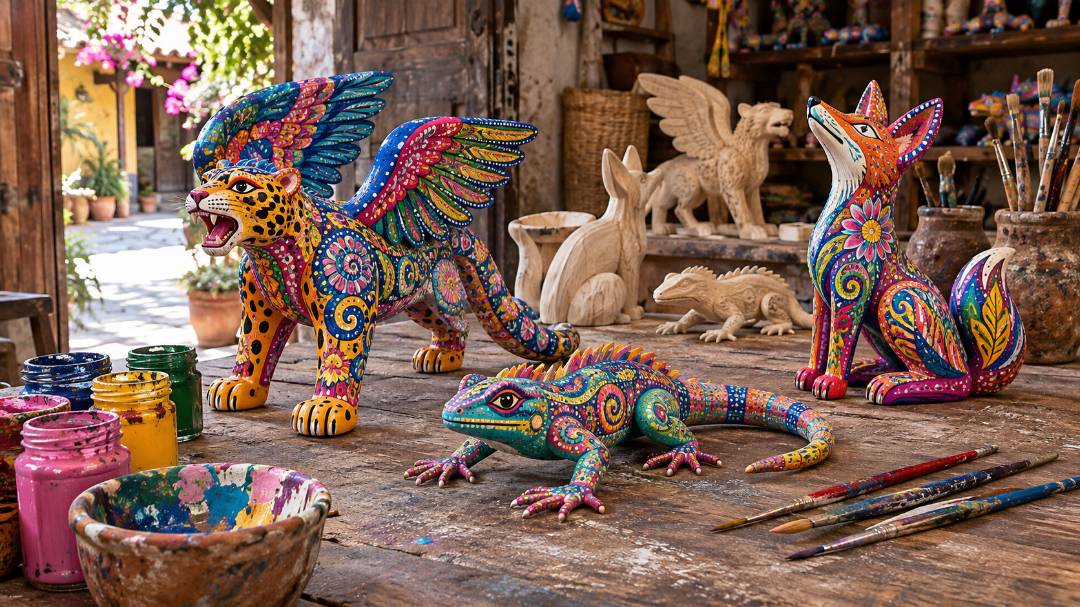
Oaxacan alebrijes are figures of real and fantastic animals carved from wood and hand-painted with intricate patterns. The term was coined in Mexico City by artisan Pedro Linares for his papier-mâché figures, but in Oaxaca the tradition took a different path: carving in copal wood.
San Antonio Arrazola, the Birthplace of the Wooden Alebrije
Arrazola lies at the foot of the hill where the Monte Albán archaeological site stands, in the municipality of Santa Cruz Xoxocotlán. It was here, in the 20th century, that Don Manuel Jiménez made the first wooden alebrijes, a tradition that his descendants and much of the village carry on today.
The figures are carved mainly from copal, although cedar, pine, pipe and willow are also used. Usually the men carve the wood, while the women, young people and children do the painting, which takes a great deal of patience and a steady hand.
Walking the streets of Arrazola, you can see the process in the courtyards of the houses, from the freshly carved trunk to the finished figure. Shared taxis leave from the city near the Central de Abasto.
San Martín Tilcajete and Its Family Workshops
Tilcajete, south of the city, is now the village best known for its alebrijes. Children grow up among copal trunks, tools and paints and learn the craft from their elders. The copal comes from different regions of Oaxaca, such as the Huatulco canyon and the Valleys themselves.
In the past, the pieces were left unpainted or darkened with soot from cooking pots, and later artisans began decorating them with aniline dyes. Today many workshops also use natural dyes made from cochineal, indigo, pomegranate, lime and lemon.
The big boost came in the 1980s, when the promotion of Oaxacan crafts opened up national and international markets. Since then, carving has largely replaced farming, and today Tilcajete’s alebrijes are sold in destinations such as Cancún, La Paz and Puerto Escondido.
From Tilcajete it’s easy to continue the route: Santo Tomás Jalieza, famous for its textiles, is about 3 km away, and Ocotlán de Morelos is less than 8 km away.
Black Clay From San Bartolo Coyotepec and Green Clay From Atzompa
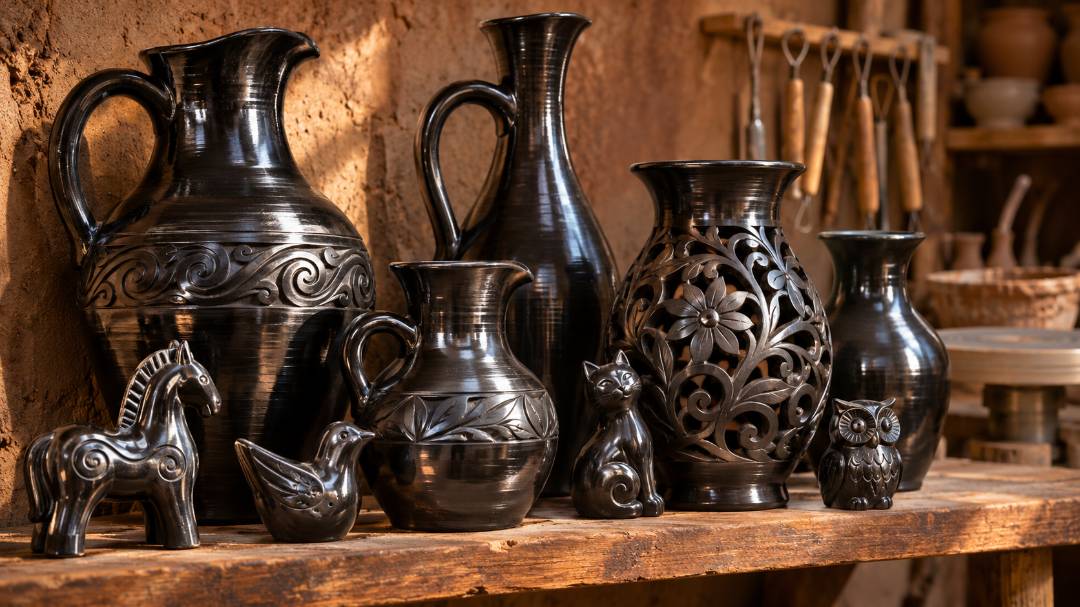
San Bartolo Coyotepec, on the road to Ocotlán, is the birthplace of Oaxacan black clay. This pottery gets its color in the kiln: at the end of firing, the oxygen is reduced, and the iron oxide in the clay turns from red to black.
The metallic sheen that made it famous is thanks to Doña Rosa Real, an artisan from the village who perfected the burnishing technique in the mid-20th century, polishing the pieces by hand with quartz stones before firing them. Doña Rosa’s family workshop still welcomes visitors and is one of the best-known stops in the village.
In the center of the village is the Oaxaca State Museum of Popular Art, listed by the Cultural Information System on Independencia street. Its history began in 1905, when a local resident, Don Manuel Guzmán, donated the land for a cultural center. Today it displays black clay pieces and works from other traditions across the state, and it makes a good introduction before visiting the workshops.
Santa María Atzompa, about 9 km northwest of the city, keeps up the tradition of green glazed pottery: jugs, pots, casseroles and decorative pieces. The village has its own craft market, open all week, and by tradition the potters don’t work the clay on Sundays.
On Fridays you can often see smoke rising from the kilns of Atzompa, because that’s when the pieces are fired to be sold the next day at the Central de Abasto in the capital. The clay is brought from the mines of San Lorenzo Cacaotepec, about 4 km from the village.
Rugs From Teotitlán del Valle
Teotitlán del Valle, 30 km east of the city of Oaxaca, is the Zapotec village known for its wool rugs. They are woven on foot-pedal looms with sheep’s wool, and many workshops dye their yarn with natural dyes.
The most famous is cochineal, known before the Spanish Conquest as the red gold of Oaxaca. According to a report by UnoTV, raising the insect on nopal cactus pads takes about three months, and dyeing one kilo of wool takes around 300 grams of cochineal ground on a metate.
Besides cochineal for reds, artisans use indigo for blues, dried pomegranate, walnut shells, copal bark, pericón (Mexican marigold) and other plants. Rugs made with aniline dyes are also part of the local tradition, so it’s worth asking at each workshop which dyes they use.
A simple way to tell them apart is to ask to see the materials. Workshops that use natural dyes usually show the cochineal, indigo and plants, and their colors tend to be less uniform and softer than chemical ones.
Where to Shop in the City and How to Plan the Route
If you don’t have time to leave the capital, the Mercado de Artesanías, on the corner of Zaragoza and J. P. García in the Centro, brings together textiles, pottery, alebrijes and other pieces from all over the state. The Central de Abasto is open every day, and Saturday is market day, when producers and potters arrive from the Central Valleys.
The villages also have their own market days. On Fridays there’s the tianguis in Ocotlán de Morelos, with knives, textiles, leatherwork and painted pottery, and on Sundays the one in Tlacolula, on the way to Teotitlán. Ocotlán is also the hometown of the painter Rodolfo Morales.
The end of the year is especially lively. On December 23 the city celebrates the Night of the Radishes, with figures carved from radishes on the Zócalo, and in the weeks before Christmas the markets fill up with crafts and decorations. It’s best to arrive early at the workshops and markets during this time.
| Village | Craft | Location | When to Go |
|---|---|---|---|
| San Antonio Arrazola | Copal alebrijes | At the foot of Monte Albán, Xoxocotlán | Any day |
| San Martín Tilcajete | Copal alebrijes | South, less than 8 km from Ocotlán | Combine with Ocotlán on Friday |
| San Bartolo Coyotepec | Black clay | South, on the road to Ocotlán | Any day, museum Tuesday to Sunday |
| Santa María Atzompa | Green glazed pottery | 9 km northwest of the city | Craft market all week |
| Teotitlán del Valle | Wool rugs | 30 km east of the city | Combine with Tlacolula on Sunday |
| Ocotlán de Morelos | Painted pottery, knives | South, at the end of the corridor | Friday, market day |
The southern route is easy to do in a day: San Bartolo Coyotepec, Santo Tomás Jalieza, San Martín Tilcajete and Ocotlán are all on the same corridor. The eastern route links Tlacolula and Teotitlán del Valle, and Arrazola and Atzompa are easy to combine with a visit to Monte Albán.
If you don’t drive, you can book a craft village tour. On platforms such as GetYourGuide, the Tilcajete, Jalieza and Ocotlán route starts at about $42 per person, and alebrije painting workshops at about $53.
Many travelers save this route for their last day, before their flight or overnight bus, after checking out of the hotel. So you don’t have to carry your suitcase around the workshops, the Qeepl luggage storage service helps you find a verified location near the ADO Terminal, the AU Terminal or the center from MX$73.90 per day per bag, and you can pick it up on the way to Oaxaca Airport.
Tips for Buying Authentic Crafts
With so many pieces for sale, it’s worth knowing how to tell handmade work from factory copies. These details help:
- buy directly at the workshop or at artisan markets, where you can meet the person who made the piece;
- look for the signature or workshop name on the base of alebrijes, which many artisans add to their work;
- ask about the wood and the dyes, because an artisan can always explain how their work was made;
- be wary of identical mass-produced pieces and of prices that are too low for the size and detail;
- bring cash, since many village workshops don’t accept cards and ATMs are scarce;
- ask for black clay to be wrapped well, as it’s fragile, and carry it in your hand luggage if you’re flying;
- avoid haggling too hard, because each piece represents days or weeks of work.